The St. Regis Budapest Opens Inside Klotild Palace
Budapest’s Belle Époque landmark enters a new chapter with St. Regis service, Danube-facing suites and a strong sense of place.
The St. Regis Budapest has opened inside Klotild Palace, bringing the brand to Hungary for the first time. Set moments from the Danube, the hotel restores one of the city’s most recognisable architectural landmarks, pairing St. Regis rituals with a palace long associated with arrival, ceremony and Budapest’s Golden Age.
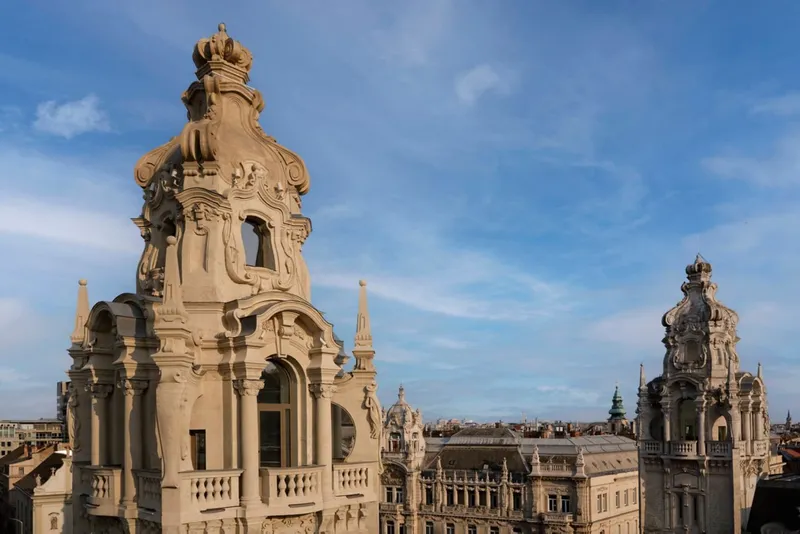
Commissioned at the turn of the 20th century by Her Imperial and Royal Highness Princess Klotild of Saxe-Coburg and Gotha, Klotild Palace was designed by Flóris Korb and Kálmán Giergl. The Neo-Baroque building once marked the ceremonial entrance to Pest from Elisabeth Bridge, crowned by a 48-metre tower with enlarged replicas of Archduke Joseph Karl’s crown.
The hotel has 63 rooms and 39 suites, including the Klotild Tower Suite and a two-bedroom Presidential Suite spanning 169 square metres with a private balcony facing the Danube, Elisabeth Bridge and Citadella. Guestrooms are conceived as private theatre boxes, a nod to Budapest’s opera culture and the Hungarian State Opera House, which opened in 1884.
The St. Regis Budapest stands as a remarkable expression of architectural heritage, one that feels inherently aligned with the legacy of St. Regis. — George Fleck, Senior Vice President and Global Brand Leader, St. Regis Hotels & Resorts
Details are layered rather than loud. Refreshment centres recall traditional Hungarian tile stoves, while shaded fabrics, brass accents and decorative tiles bring in Art Nouveau references. Across the interiors, the Danube appears through soft blue tones, fluid patterns and reflective finishes, joined by ceramic textures inspired by Hungary’s bath culture.
The arrival experience builds on that sense of movement. A grand staircase is imagined as a vertical river of light, framed by sculptural ceramics, reflective surfaces and a glass ceiling with floral bronze patterns and crown-shaped chandeliers. The Passage, formerly a porte cochere, now connects the welcome area with meeting spaces through suspended mirrors, arched ceilings and layered lighting.
The St. Regis Bar takes its cues from the stage, with sculptural alcoves and a glass mural reimagining an orchestra at the Hungarian State Opera House. Its local Bloody Mary interpretation, The Crown Mary, references both Klotild Palace and the Red Snapper, first created at The St. Regis New York in 1934. Head Mixologist Norbert Tengely shapes the cocktail programme around simplicity and precision.
Dining adds an international register. 99 Sushi Bar & Restaurant focuses on premium ingredients, Japanese technique and modern presentation, with a show kitchen and private dining room for seasonal omakase led by Chef Thinus van der Westhuizen, Group Culinary Director of Ninety-Nine. Klotild Patisserie brings Hungarian and French-Viennoiserie pastry, artisanal coffee and a bespoke limited-edition blend to a historic apothecary setting.
The St. Regis Spa is intimate, with an indoor pool, traditional hammam, Finnish sauna, experience showers and three treatment rooms. Treatments combine scientific innovation with Budapest’s bathing heritage through partnerships with Sothys and Omorovicza, the local skincare house rooted in the city’s thermal culture. A Celebration Bar extends the relaxation sequence, while the sixth-floor fitness studio sits beneath a glass roof.
The hotel also carries the St. Regis idea of social ritual into its event spaces, including the John Jacob Astor Boardroom, three salons and the grand Caroline Salon. Its position near the Danube places guests close to Elisabeth Bridge, the Citadella and the city’s central cultural landmarks, while Klotild Palace gives the stay a distinctly Budapest address: historic, theatrical and carefully renewed.
For further information, visit marriott.com


