The Orient Express Train Returns: Art Deco, Reborn for 2027
Orient Express unveils its future train inside the Musée des Arts Décoratifs, previewing 1920s glamour reinterpreted for contemporary travel.
The world’s most storied train is preparing a return, recast as the ultimate expression of slow, cinematic luxury. Inside Paris’s Musée des Arts Décoratifs, amid Lalique glass and Art Deco icons, Accor has unveiled the reborn Orient Express, due to welcome its first guests in 2027. Framed by the exhibition “1925–2025: A Century of Art Deco,” the reveal positions the train not as a replica, but as a cultural statement linking the glamour of 1920s rail travel with today’s renewed appetite for craft and narrative.
This new chapter begins far from Paris, on a forgotten siding near the Poland–Belarus border. It was there that historian Arthur Mettetal located long-lost blue coaches from the 1920s and ’30s, formerly part of the Nostalgie-Istanbul-Orient-Express. Returned to France, these 17 carriages are now being restored and reimagined by architect Maxime d’Angeac, whose work for French maisons has honed a particular talent for making heritage feel effortlessly contemporary.
Rather than freezing the past in amber, d’Angeac treats the original cars as a moving gallery of French decorative arts. Historic marquetry, Lalique panels and period details are conserved and elevated by elite ateliers, while new partitions pair precious woods and leather in patterns that echo Suzanne Lalique’s rail motifs. Technology is invisibly embedded: climate control, acoustic insulation and tuned lighting are woven into the fabric so that what the guest experiences is not engineering, but atmosphere.
The 17-car train will comprise sleeping, dining and lounge cars, each conceived as both stage and sanctuary. In the suites, classic carriage geometry is softened by curved corners and elliptical shelving, creating a gentle, residential flow. By day, the space feels like a private salon, with sofas and settees inviting reading, conversation or quiet contemplation of the landscape beyond the window. By night, staff perform what is dubbed “the Great Transformation”, converting the suite into a generous bed with an almost balletic efficiency. Bathrooms are finished in marble with sliding doors and carefully tuned lighting, deliberately more pied-à-terre than compartment.
If the suites are about retreat, the social spaces are about theatre. The Dining Car reinvents grand European service under a mirrored, arched ceiling that casts a warm, flattering glow. Napa-topped tables and tailored armchairs are arranged with architectural precision, while a more intimate lounge revives original marquetry panels for the feel of a travelling salon. Behind glass, an open kitchen will bring the choreography of the brigade into view, with menus expected to follow a seasonal, region-led philosophy that takes its cues from the very landscapes the train traverses.
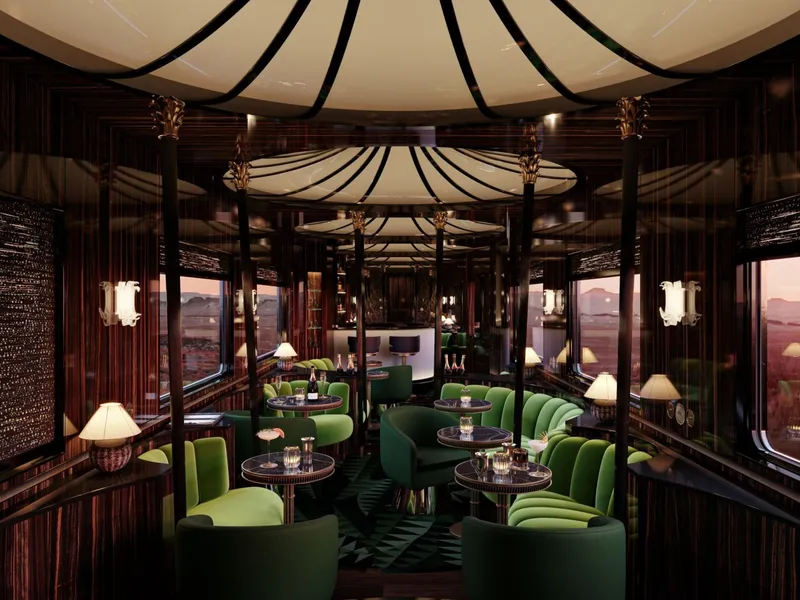
The Bar Car is poised to become the emblematic image of the train. Second Empire-style light domes in deep greens hover above rosewood and marble; historic Lalique “flower” lamps punctuate the room with soft light. Large windows, framed by embroidered curtains, turn rivers, valleys and city approaches into a moving backdrop for aperitifs and nightcaps. It is easy to imagine strangers becoming companions here, and journeys remembered as much for conversations shared as for destinations reached.
Wellness is quietly engineered into the experience rather than announced. Blackout strategies, vibration control and balanced ventilation work together to deliver a rare commodity: genuinely restorative sleep on the rails. Lighting scenes shift seamlessly from reading to night mode, while materials—leather, wool, wood—are chosen as much for their tactile calm as their visual impact.
At the apex sits a full-car Presidential Suite, reading more as a private residence than a traditional cabin, with salon, bedroom, marble bathroom and an intimate “Cabinet de l’Égoïste” for moments entirely one’s own.
The train is also the flagship of a wider Orient Express ecosystem. La Minerva in Rome has already opened as the brand’s first hotel; Venice will follow in 2026 with a palazzo on the canals; and the Corinthian sailing yacht will extend the story to sea. When the train finally departs in 2027, its itineraries are expected to favour scenic pacing and ritual over speed—a grand tour for a time when true luxury is measured not just in objects, but in the quality of the journey itself.


