Van Cleef & Arpels Brassée de Lavande Automaton
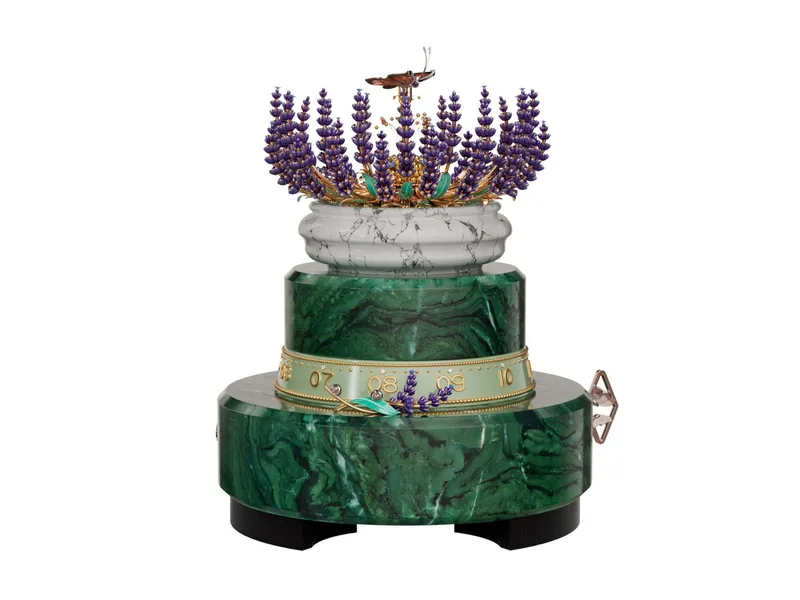
The Brassée de Lavande brings Van Cleef & Arpels’ narrative watchmaking to a sculptural scale. Conceived as an “armful of lavender,” its animation is on-demand: thirty-six rose gold sprigs open in a gentle swell while a butterfly emerges and beats its wings in time with a discrete carillon. Time is displayed on a rotating ring—yellow gold and diamond hour markers guided by two white gold snails—so the spectacle remains uninterrupted.
Founded in 1906 on Place Vendôme, the Maison has long folded poetry into mechanics, from Poetic Complications to Extraordinary Objects. Brassée de Lavande belongs to the latter: an haute-jewellery automaton conceived by the Paris Studio and realized in the Sainte-Croix workshops, where the brand’s automata expertise has matured into a modular know-how adaptable to new stories.


Every creation starts with a story. Lavender corollas slowly unfold, revealing a butterfly twirling in an aerial dance before finding refuge within the bouquet’s heart. — Van Cleef & Arpels
Two distinct trains sit beneath the verdite base. The first orchestrates the choreography: the progressive opening and closing of the 36 sprigs and the butterfly’s measured flight, synchronized to the carillon’s timbre. The second drives the clockwork ring for time display, ensuring legibility without disturbing the tableau. The animation’s fluidity—designed to evoke a breeze coursing through the bouquet—was achieved through years of in-house R&D, refining torque delivery, sequencing, and damping for a natural cadence.


Materials and craft serve the narrative. The butterfly’s white gold wings are pierced for plique-à-jour enamel, producing a stained-glass translucence that modulates light like a miniature vitrail. Black enamel contours sharpen the geometry, while diamond pavé meets a tiger’s eye abdomen and amethyst cabochon eyes for warm contrast. Each lavender corolla was formed, reshaped, and polished in gold, then lacquered by Catherine Nicolas—Meilleur Ouvrier de France—with fifteen micro-layers to achieve depth and hue stability; the gold was pre-textured to improve lacquer adhesion. The verdite base grounds the palette with a variegated green that complements the purple spectrum of the sprigs.
Assembly in Sainte-Croix involved more than fifteen métiers across France and Switzerland—lapidary, enameller, cabinetmaker, automaton maker, watchmaker, composer, and bell maker among them. Total build time reached approximately 3,466 hours, split between 2,066 hours in the High Jewelry workshop and around 1,400 hours for movement and assembly. The carillon’s acoustics were tuned to accompany the butterfly’s tempo, a delicate balance of resonance and mechanical load so the animation remains smooth across the entire sequence.
 Upon request
Technical Specifications
- Movements: Two separate movements, made in Sainte-Croix
- Animation: One drives the lavender and butterfly with the carillon
- Timekeeping: The other drives the rotating time ring
- Power Reserve: 8 days for the clock movement
- Function: On activation, 36 rose gold sprigs open. A butterfly rises and flutters to music. The sequence lasts ~45 seconds
- Time Display: A rotating band shows the time with golden beads and yellow gold diamond markers. Two white gold snails with lavender sprigs indicate the hours
- Dimensions: Approx. 27 cm high, 21.5 cm wide
- Base: Two-tier verdite with a howlite stone bowl
- Lavender: 36 hand-shaped rose gold sprigs, airbrushed lacquer for depth
- Butterfly: High-jewelry construction
- Wings: White gold with black enamel, diamond-set, and plique-à-jour enamel
- Body/Eyes: Tiger’s eye body, amethyst cabochon eyes, diamond-tipped antennae
Curators Community
Through our international Curators Community, we connect our Insiders and Members with top-tier watch advisors to meet their diverse timepiece needs.


